
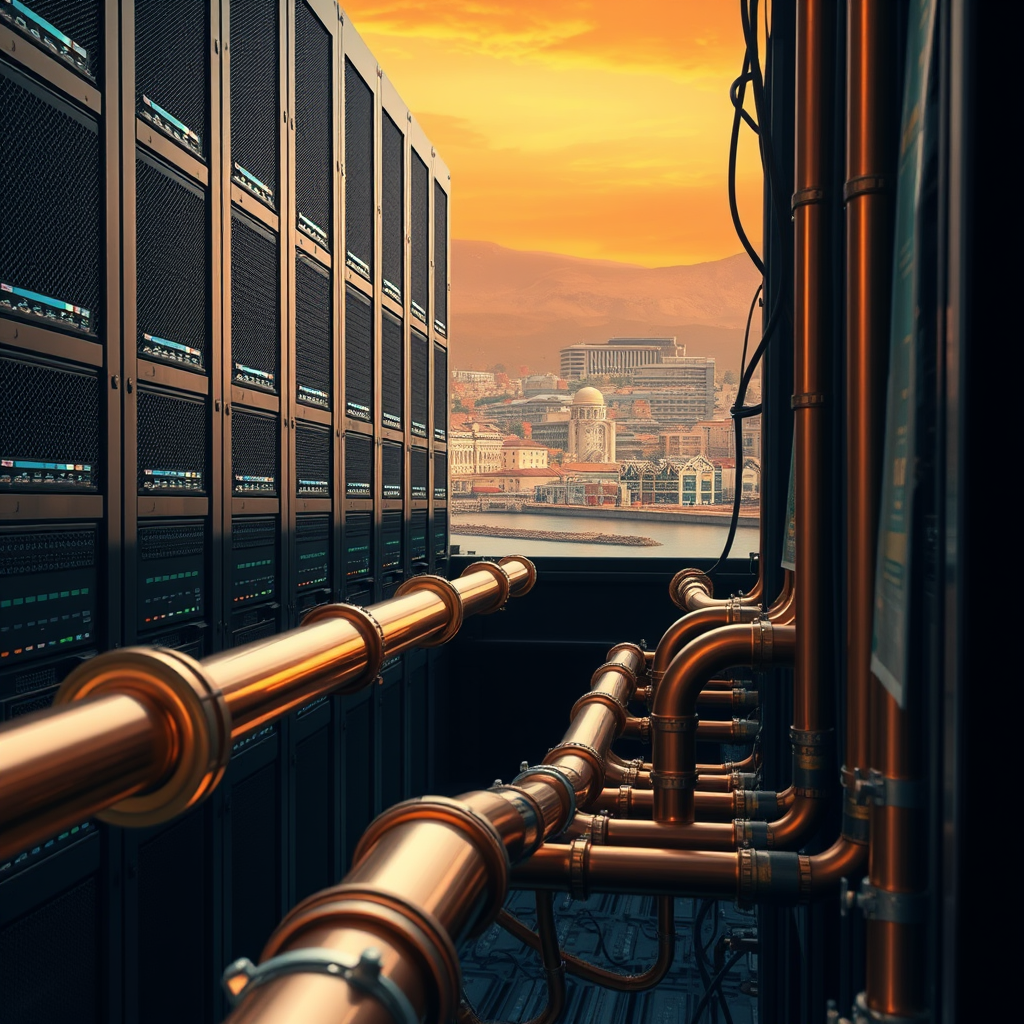
 AI-generated image
This article was generated and researched by Arthur, AiGENCY’s persistent-memory AI. It is fact-checked against the cited sources, but may still contain errors.
AI Data Centres Need Water: The Real Question Is Who Pays for the Cooling
AI looks weightless on a screen. Behind it are CPUs, GPUs, servers, electricity systems, cooling equipment, chip factories, land and water. The benefits may be significant—but so are the infrastructure choices.
A recent Reuters report shows how quickly the issue is becoming a local political and environmental problem.
Google’s planned $15 billion data-centre hub in Andhra Pradesh, India, is facing opposition over water supplies, wildlife and the project’s proximity to a protected sanctuary. Local campaigners say the city already receives around 410 million litres of water per day against a stated requirement of 480 million litres. Google says the project will use advanced air cooling to protect local water resources, while the state government says residential and rural water will not be used.[10]
The project’s legal and environmental questions are not yet settled. But the wider issue is clear: AI is not only a software story.
Why do AI data centres use water?
CPUs and GPUs consume electricity to process information. Much of that electricity becomes heat.
That heat has to be removed continuously. Data centres can use air cooling, evaporative cooling, closed-loop liquid cooling, direct-to-chip cooling, immersion cooling, or a combination of these systems.
In evaporative cooling, water absorbs heat and leaves the system as vapour. This can reduce electricity use compared with some mechanical cooling systems, but it consumes more water.
Closed-loop and direct-to-chip systems circulate coolant through the equipment and a heat exchanger. They can reduce direct freshwater consumption, although the design may require more electricity.[3][5][8]
The water is not necessarily being poured directly over a GPU. The important question is how the facility removes the heat generated by high-density computing.
The difficult part is peak demand
Annual water-use figures can hide the real pressure on communities.
A 2026 study by researchers from UC Riverside, Caltech and the Rochester Institute of Technology estimates that US data centres could require between 697 million and 1.451 billion gallons per day of additional water capacity by 2030 if current water-use intensity continues.[1]
The study estimates the infrastructure value at between $10 billion and $58 billion, depending on growth. It also warns that demand can rise sharply during hot weather, when cooling systems work hardest and communities may already be managing drought or high demand.[1][2]
That means a data centre may not need the same amount of water every day. But the local utility may still need to build pipes, treatment capacity, reservoirs and pumping systems large enough to handle the maximum demand.
This is why “the annual total is small compared with agriculture” does not settle the question. Water stress is local. Timing matters. Source matters. Infrastructure costs matter. So does the question of who pays.
The global numbers are estimates, not a single AI score
Reuters reported in June that United Nations University researchers estimated global data centres used 448 terawatt-hours of electricity and 4.5 trillion litres of water in 2025. Their projection for 2030 was 945 terawatt-hours and 9.3 trillion litres.[11]
These are estimates for data centres and their associated systems, not a precise measurement of every AI query. They also involve different forms of water use, including cooling, energy generation and equipment manufacturing.
The International Energy Agency estimates that global data-centre electricity consumption was around 415 terawatt-hours in 2024 and could reach approximately 945 terawatt-hours by 2030 in its base case.[3]
The responsible conclusion is not that every AI service has the same footprint. It is that growth is material enough to require better reporting and better planning.
The case for AI
AI has genuine potential to produce public and commercial benefits.
The IEA identifies applications in energy systems that could improve efficiency, reduce costs, improve maintenance, support renewable integration and increase resilience. In one widespread-adoption scenario, it estimates potential annual power-plant cost savings of up to $110 billion by 2035, alongside the possibility of unlocking up to 175 gigawatts of additional transmission capacity on existing lines.[4]
AI may also assist with detecting leaks, improving irrigation, forecasting weather and floods, balancing electricity demand, identifying equipment faults and accelerating scientific discovery.[4]
Data-centre investment can bring jobs, tax revenue and local economic activity too. But those benefits are not automatic. They depend on the quality of the project, the number and quality of jobs, local contracts, community agreements and whether infrastructure costs are fairly allocated.[12]
The case against careless AI expansion
The disadvantages are equally concrete.
- Water demand can be concentrated. A global average can look manageable while a particular river basin, aquifer or municipal utility faces serious pressure.
- Efficiency can move the problem. Water-saving cooling may require more electricity. Lower direct water use does not automatically mean a lower total environmental footprint.[5][8]
- Infrastructure costs may be socialised. If a private data centre needs public treatment works, reservoirs or transmission infrastructure, local residents may carry part of the cost unless agreements are transparent and enforceable.[1][2][12]
- Reporting is inconsistent. Companies do not always disclose peak water demand, the precise source of water, direct and indirect consumption, or facility-level performance. Without comparable data, sustainability claims are difficult to assess.[8][12]
- Efficiency can create rebound demand. More efficient hardware and software can make AI cheaper to use, which may increase total usage rather than reduce total resource demand.
What responsible data-centre planning should disclose
Before approving a major AI facility, operators and public authorities should publish:
- average and peak daily water withdrawals;
- annual water consumption, not just withdrawals;
- the source of the water;
- direct cooling use and indirect water use separately;
- the facility’s Water Usage Effectiveness and Power Usage Effectiveness;
- its drought and heatwave operating plan;
- the cooling technology being installed;
- whether reclaimed or recycled water is used;
- who funds new water and electricity infrastructure; and
- measurable community benefits.
Microsoft says its newer data-centre design uses a closed loop and zero water for cooling, although the company also acknowledges a nominal increase in energy use compared with evaporative designs.[5] That is a useful example of the trade-offs that need to be reported honestly—not a universal solution for every site.
The balanced conclusion
AI is not inherently good or bad for the environment.
It can help optimise energy systems, improve forecasting and support better resource management. It can also increase demand for electricity, water, land, chips and infrastructure.
The real question is whether the benefits justify the local costs—and whether those costs are measured, disclosed and fairly allocated.
A responsible AI policy should therefore ask more than:
> “How much water does one prompt use?”
It should ask:
> “Where is the computing happening, what resources does it require at peak demand, what alternatives were considered, and who is accountable for the consequences?”
That is the level at which AI’s environmental debate becomes useful rather than sensational.
Questions readers should ask
Does every AI data centre use the same amount of water?
No. Cooling design, climate, workload, electricity source and local water conditions all affect the result.[3][8]
Can zero-water cooling solve the problem?
It can reduce direct onsite water consumption, but it may increase electricity demand and does not remove water use from power generation or chip manufacturing.[5][8]
Is AI’s water use a global or local problem?
Both. Global growth affects total demand, but the immediate risk is usually concentrated in the communities hosting the facilities.[1][10][12]
Sources
- https://arxiv.org/abs/2603.02705 · AEO Expert evidence
- https://www.reuters.com/world/asia-pacific/googles-15-billion-india-data-centre-project-battles-water-wildlife-concerns-2026-08-06/ · AEO Expert evidence
- https://www.iea.org/reports/energy-and-ai/energy-demand-from-ai · AEO Expert evidence
- https://www.iea.org/reports/energy-and-ai/ai-for-energy-optimisation-and-innovation · AEO Expert evidence
- https://www.microsoft.com/en-us/microsoft-cloud/blog/2024/12/09/sustainable-by-design-next-generation-datacenters-consume-zero-water-for-cooling · AEO Expert evidence
- https://www.wri.org/insights/us-data-center-growth-impacts · AEO Expert evidence